ባህላዊ የእርሻ መሳርያዎች

Traditional Cultivating Tools

Stamp Info
Stamp ID: 1060
Size:
40 X 30 mm.
Quantity:
100,000
Date of Issue:
September 7, 1995
Denominations:
Birr 0.15, 0.35, 0.50, 1.00
Process of Printing:
Lithography in four colors
Printed by:
Edition 2002-Germany

Stamp Introduction

First Day Covers are available at Addis Ababa General Post Office and its branches, Adigrat, Akaki, Arba Minch, Assela, Awasa, Axum, Bahir Dar, Kebre-Mengist, Debre-Berhan, Debre-Markos, Debre-Zeit, Dembi-Dolo, Hossana, Dessie, Dilla, Dire Dawa, Fitche, Gambella, Ghion, Ginnir, Goba, Jinka, Gondar, Gore, Harar, Mekele, Mettu, Hagere-Hiwot, Nina, Nazareth, Negele Borena, Nekemte, Shashemene, Wolaita-Sogo and Yirgalem Post Offices on the day of issue.

Orders for stamps and F.D.Cs (in advance payment) to the Ethiopian Postal Service, Philatelic Section Post Box 1112, Addis Ababa, Ethiopia or to Philatelic Agencies of the Transitional Government of Ethiopia Campo-Rodan 9 Rue du Lombard 13-1,000 Brussels, Belgium for Europe, British Isles and the Commonwealth countries or IGPC P.O. Box 4107 Grand Central Post Office 460 West 34 Street New York City. N.Y 10001 U.S.A for North, Central and South America.

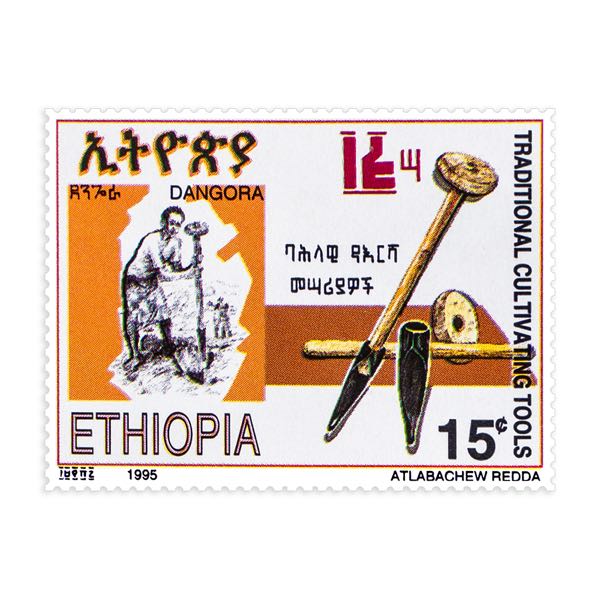
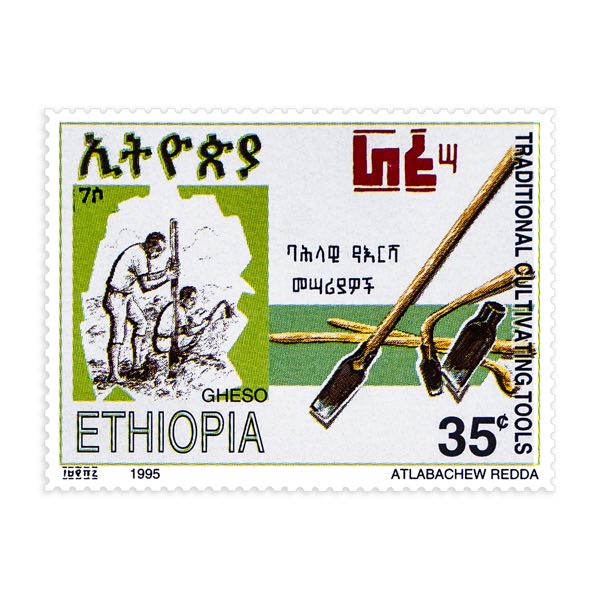
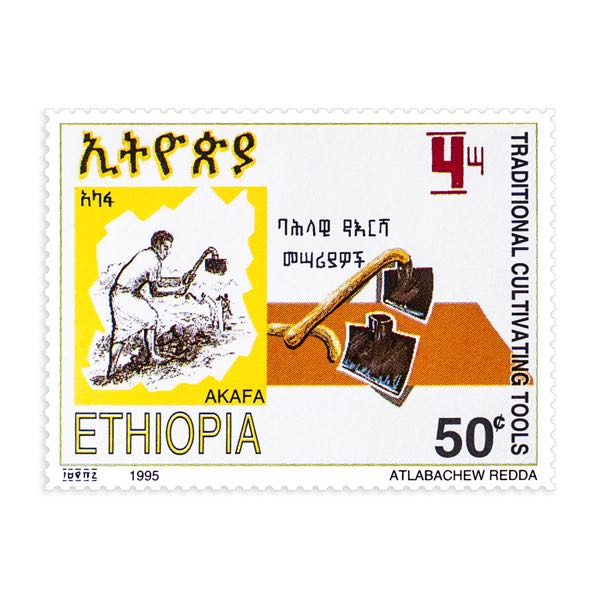
There are different kinds of traditional farming implements used by the Ethiopian farmers. Using these implements many products, some of which are endemic to, Ethiopia is grown. The Ethiopian plough, mainly pulled by a pair of oxen, for which a commemorative stamp was issued sometime before has been used for about two thousand years. In this issue other four kinds of traditional cultivating tools which are locally known as ” Dangora”, “Gheso”, “Akafa” and “Ankase” are depicted and described beneath.

Dangora

It is a digging stick having a wooden handle with one or two fire hardened points, often with sharp metal tips. The tool is made heavier by fixing a stone to the upper part. Peasants. use the stick in groups of live or six working in fine and advancing together in step. The sod is removed in blocks and turned over onto its humus laver without bringing up the poor soil from below. The weighted stick is used largely in reclaiming hard soils and allows work to begin on the land, ` even during the dry. season. In this way the soil is able to absorb humidity from the moment the short rains begin. This ”’ tool is much used by the Gurrage & in Hararge.

Gheso

It has a long wooden handle to which a prong is strapped. It is commonly used for planting tubers although the risk of cutting the tuber often makes another tool preferable. It is Used to loosen the soil around the tuber and so extract the couch grass which chokes them. It is widely used in Welayita.

Akafa

It is another kind of hoe used in Hararge. It has a wooden handle, sharply bent at one end to form a hook on which a metal implement can be fixed. The tool functions as a hoe and breaks up the top soil.

Ankasse

It is a digging stick having a wooden handle with pointed metal end. The tool is used to dig holes in which plants can be planted.